

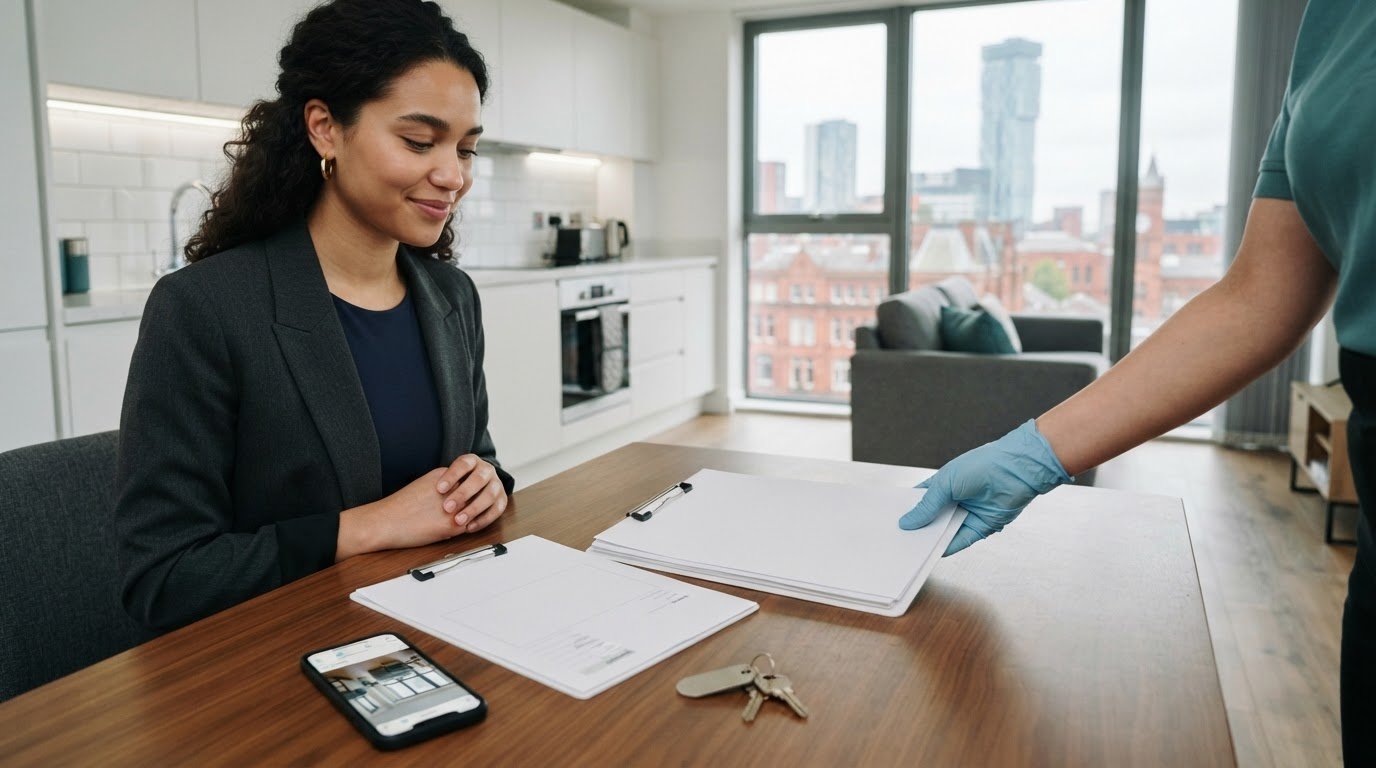
A cleaning receipt can show that work was booked, but not that the property was ready for handover. If you’re wondering how to prove a property was professionally cleaned, create a dated evidence trail that links the service to the property’s condition and the agreed cleaning scope.
An invoice alone may not show which areas were cleaned or how the property compared with its check-in condition. Clear, relevant records make that connection easier to understand and help you respond calmly if a check-out report raises a concern.
This guide explains what to keep, from booking confirmations and invoices to time-stamped photos, and how to compare those records with the inventory and check-out report. You’ll also learn what to do if the report identifies a cleaning concern. A professional end-of-tenancy clean, such as Apartment Clean’s service in Manchester, can form one part of a well-documented handover. The aim is to keep a credible record of the work and the property’s condition in one place.
Key Takeaways
- Learn how to prove a property was professionally cleaned with dated records showing who cleaned, when, which areas were covered and what they looked like afterwards.
- Build a simple evidence trail by keeping booking details, recording the agreed scope and taking clear photos once the clean is complete.
- Use the check-in inventory, cleaning records, photos and check-out report together to compare the same rooms and surfaces.
- If a cleaning issue is disputed, identify the area, gather relevant records and respond in writing with a clear comparison.
- See how a professional end-of-tenancy clean in Manchester can contribute to a more organised property handover.
What counts as proof that a property was professionally cleaned?
Useful proof is a set of records that shows who carried out the clean, when it happened, which areas were included and what condition the property was in afterwards. No single document is likely to answer all four questions. A booking confirmation shows that a visit was arranged, while a payment record shows that money changed hands. Neither necessarily demonstrates the finished condition of every room.
This distinction matters at handover. Cleaning records can explain what work was arranged and support a discussion about the property, but they can’t guarantee a particular deposit outcome. Evidence is strongest when it is clear, dated and relevant to the condition being discussed.
Which records can show that a professional clean took place?
Keep the booking confirmation, any dated invoice or receipt, and written details of the agreed service scope. Save relevant messages about the appointment or its completion, too. If you receive a completion note or an area-by-area record, file it with the other documents. Together, these records can show when the service was arranged and what work it covered.
Keep the records together, with dates and the property address visible where possible. An overview of specialized domestic cleanings can help distinguish routine housekeeping from a focused service such as an end-of-tenancy clean. For practical tasks that may be covered, use a dedicated cleaning checklist rather than treating paperwork as a task list.
Does a cleaning receipt prove the property was cleaned properly?
A receipt can support the timeline by recording a payment to a cleaning service. Depending on the details shown, it may also identify the provider or service. But it doesn’t, by itself, show whether a particular surface was cleaned or what each room looked like when the work was finished.
A receipt can prove payment; dated photos and completion notes help show the property’s condition. Pair the payment record with clear, time-stamped photographs taken after the clean and, where available, a simple record of completed areas. For example, photos of the kitchen worktops, hob and sink provide more detail than one general image of the room. Keep the original files and avoid editing images in ways that could obscure what they show.
Together, these records create a more complete account than a receipt alone. They support your account, but don’t replace a comparison with the property’s check-in condition. Match each record and image to the relevant room or surface in the inventory and check-out report.
Build a clear cleaning evidence trail before and after the appointment
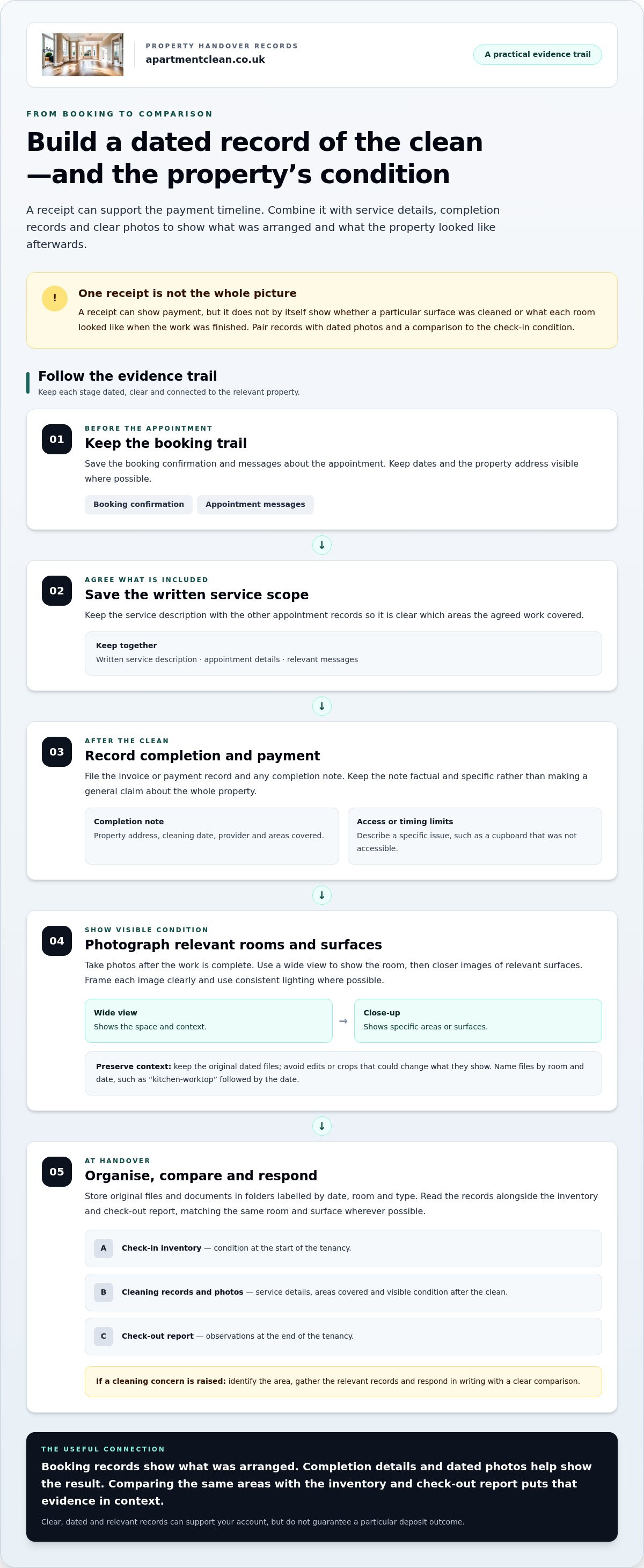
A useful record starts before the cleaner arrives. Keep the booking confirmation and messages about the appointment, then save the written service description so you can show what was agreed. After the clean, add the payment record, any completion details and photographs of the finished rooms. This sequence links the appointment to the handover instead of leaving you with disconnected documents.
What should a professional cleaning completion record include?
If you’re making a completion note, record the property address, cleaning date, service provider and areas covered. Keep it alongside the invoice or payment record and the written description of the work. Be factual about access or timing issues. For example, note that a cupboard wasn’t accessible rather than making a general claim that the whole room was incomplete. Clear, neutral details make the record easier to understand. Commercial maintenance specialists like Brilliant Office Cleaning often use structured service scopes and checklists for facility handovers, illustrating how itemised documentation makes verifying finished work much simpler.
How should you take useful post-clean photographs?
Photograph each relevant room after the work is complete. Start with a wide view to show the space, then take closer images of specific surfaces or areas. Use consistent lighting where possible, and frame each image so it’s clear what it shows. Keep the original, dated files and avoid edits or crops that could change the context. Name files by room and date, such as “kitchen-worktop” followed by the date, so you can find them quickly.
For a Manchester tenancy handover, use this compact checklist:
- Save the booking confirmation and appointment messages.
- Keep the written service description with the payment record.
- Note the date, areas covered and any access limitations.
- Take wide and close-up photos of relevant areas after the clean.
- Store original files and documents in folders labelled by date, room and type.
Keep descriptions precise and let the evidence speak for itself. If a dispute reaches a tenancy deposit scheme, GOV.UK explains its free dispute resolution service, where both parties may be asked to provide evidence. An organised record can make it easier to present your account, though it can’t determine the outcome on its own.
This process gives you a practical answer to how to prove a property was professionally cleaned: preserve the appointment trail, document the work and capture the result. For a Manchester handover, Apartment Clean’s end-of-tenancy cleaning can be part of that organised process.
Compare cleaning evidence with the inventory and check-out report
Each handover document has a different role. The check-in inventory records the property’s condition at the start of the tenancy. Cleaning records describe the service arranged and, where available, the areas covered. Photographs capture visible conditions at a particular time. The check-out report records observations at the end. Read them together, matching the same room and surface wherever possible.
A general statement that a property was “professionally cleaned” is less useful than a specific comparison. If the check-out report notes residue on the kitchen worktop, look for a post-clean image of that worktop, the relevant service description and any corresponding check-in note. An inventory or receipt can support your account, but neither automatically determines a deposit dispute.
To keep the comparison clear, make a short table or note with four columns: report observation, matching evidence, date and action taken. For example, record “bathroom basin marked” as the observation, link to the dated photograph and check-in entry, then note whether you replied or supplied further information. This makes gaps in the evidence easier to spot.
What if the check-out report says cleaning was still needed?
Focus on the exact area identified. Compare the observation with the dated photograph, check-in record and agreed cleaning scope. Then reply calmly in writing, referring to the relevant documents and explaining what they show. If the image doesn’t cover the reported area, say so plainly and provide any other relevant record. A professional clean is evidence of work carried out, not proof that every later observation must be incorrect.
For wider move-out context, see the Manchester end-of-tenancy cleaning guide.
How do tenants and landlords use the same evidence differently?
Tenants can organise booking, payment, completion and condition records to explain the steps taken before handover. Landlords or agents can use the check-in inventory as a baseline and compare it with specific check-out observations, supported by relevant images and cleaning records. In either case, keep the comparison factual and like-for-like. The evidence should clarify what changed, not simply repeat that a clean took place.
Landlords looking for broader property-management context can read the Manchester landlord cleaning services guide. For wider property presentation and upkeep, specialists such as Squirtz Property Detailing illustrate how structured checklists help owners document condition and preparation effectively. This comparison is central to how to prove a property was professionally cleaned: connect the service record to the condition documented at handover, without treating any single record as decisive.
What to do if cleaning evidence is missing or disputed
A missing invoice or a disagreement in the check-out report can feel stressful, but a clear, measured response is more useful than a broad argument. Gather the records you do have, identify the exact room or surface in question, then compare the check-out observation with the check-in report, agreed cleaning scope and any dated photographs.
How can you respond to a disputed cleaning observation?
Address the specific point, not the whole property. If the report says the oven was left dirty, refer to that observation directly and attach only evidence relevant to the oven. Label each file with what it shows and its date, then explain briefly how it relates to the report. Keep a copy of your response and note when you sent it, along with any follow-up messages.
If a document is missing, use other records to establish the appointment and condition, such as booking messages, payment records, calendar entries, completion correspondence and dated photos. Don’t assume a particular document exists, and don’t describe a record as proof of something it doesn’t show. Keep reports, photographs, invoices and correspondence together in one dated folder. Factual, consistent records make your account easier to follow.
When should you seek guidance on a deposit dispute?
Cleaning evidence can support your account, but it’s separate from the formal process for resolving a deposit disagreement. The applicable tenancy agreement, deposit scheme and circumstances may affect the steps involved. Check current official guidance and the rules of the scheme protecting the deposit before acting, particularly if you need to understand its process or any time limits. GOV.UK explains how to raise a tenancy deposit dispute; avoid relying on general advice for details that may depend on your situation.
For other handover preparation, read the guide to moving out of a Manchester rental. Apartment Clean provides end-of-tenancy cleaning in Manchester, which can be one part of a well-documented handover.
The practical answer to how to prove a property was professionally cleaned is to keep an accurate record and connect it to the specific point being discussed. If evidence is incomplete, be transparent about the gap and provide the relevant information you can support.
Arrange a professional end-of-tenancy clean in Manchester and keep the record
A professional end-of-tenancy clean can bring structure to the final handover, particularly when you’re preparing a furnished flat, shared house or family home for a check-out inspection. It gives you a clear point in the timeline to document: the service was arranged, the agreed work was carried out, and you recorded the property’s condition before returning the keys.
Apartment Clean provides end-of-tenancy cleaning across Manchester and surrounding areas, with a service designed around professional inventory standards. The team brings professional-grade equipment and uses non-toxic, eco-friendly products. Cleaning is one part of your handover evidence, so keep your own records of the booking and the finished property rather than relying on the service alone to demonstrate its condition.
What to prepare before booking a Manchester end-of-tenancy clean
Share practical details that help shape the service: the property type, handover timing and any relevant inventory or check-out requirements. Point out areas needing particular attention, such as the kitchen, bathroom or carpets. Keep the agreed service information with your tenancy and handover documents. A clear record of what was arranged makes it easier to understand how the clean relates to the property’s requirements.
How to finish the handover with an organised record
Once the appointment is arranged, save the booking confirmation and messages about the agreed work. Keep the invoice or receipt when you receive it, along with any completion correspondence. These records help establish the appointment timeline, but they don’t replace your own evidence of the result.
After the clean, take dated photographs of relevant rooms and surfaces before handing back the property. Capture wide views as well as details, and keep the original files. Then compare your records with the check-out report. If it identifies a specific difference, gather the relevant image and document and respond to that point clearly.
This is a practical way to approach how to prove a property was professionally cleaned: pair the service records with dated evidence of the condition at handover. Keep everything together, organised by date and room, so it’s straightforward to retrieve if questions arise.
For a more organised move-out, arrange end-of-tenancy cleaning in Manchester with Apartment Clean and keep your handover records together from booking through to key return.
Make your property handover easier to document
Knowing how to prove a property was professionally cleaned comes down to keeping a clear, credible record. Save the booking and payment details, photograph the finished rooms, and compare specific areas with the check-in inventory and check-out report. Together, these records can explain what was arranged and show the property’s condition, without relying on a receipt alone.
A professional end-of-tenancy clean can add structure to your handover. Apartment Clean provides this service in Manchester, with work designed around professional inventory standards. The team supplies its own professional-grade equipment and uses non-toxic, eco-friendly products. Keep your own dated photos and records alongside the cleaning paperwork for a more complete picture.
Ready to organise your move-out clean? Arrange a professional end-of-tenancy clean in Manchester, then complete your handover record at your own pace. A calm, well-organised process can help you move forward with greater confidence.
Frequently Asked Questions
What is the best proof that a property was professionally cleaned?
The strongest proof is a dated set of records that connects the cleaning appointment to the property’s condition. Keep the booking confirmation, invoice or receipt, written service details, any completion correspondence and clear photos taken after the work. Compare these with the check-in inventory and check-out report, matching the same rooms and surfaces. Together, these records provide a more complete account than a single document or a general statement that the property was clean.
Does a cleaning receipt prove a property was professionally cleaned?
A receipt can show that payment was made for a cleaning service, but it may not establish which areas were covered or what condition they were in afterwards. Keep it with the booking information, written service description and dated photographs of the finished rooms. If a check-out report later raises a concern, these records can help connect the service to the specific area in question. A receipt supports the timeline, not every detail of the result.
Can a landlord reject professional cleaning evidence?
A landlord or agent may question whether evidence relates to a particular cleaning concern, but one record does not automatically settle a disagreement. For example, a receipt may show that a clean was paid for, while a photo may only show one room. Compare the specific check-out observation with the check-in inventory, agreed service details and relevant images. If the disagreement concerns a deposit, follow the applicable scheme’s current process and provide clear, relevant records.
How do I prove a property was clean when I moved out?
To show the property’s move-out condition, keep dated photos or videos of relevant rooms and surfaces, alongside the check-in inventory and check-out report. Add cleaning records if a professional service was arranged. Match evidence to specific observations: a clear image of the bathroom basin is more useful for a basin-related concern than a general photo of the flat. Keep original files and organise documents by date and room so you can find them easily.
Are photos enough to prove a professional clean?
Photos are useful evidence of visible condition, but they may not prove who cleaned the property, when the work took place or what service was arranged. Take wide shots to show the room and close-ups of relevant surfaces, keeping original, dated files. Pair them with booking details, payment records and any written service information. Photos also have limits: an image can only show what was captured, from that angle and at that time.
What should I do if I have no cleaning receipt?
Gather other records that help establish the appointment and the property’s condition. Check booking emails, text messages, bank or card statements, calendar entries, completion correspondence and dated photos. Keep your notes factual and avoid describing a document as proof of something it doesn’t show. If a deposit disagreement follows, check the current guidance from your tenancy deposit scheme.
Does professional end-of-tenancy cleaning guarantee my deposit back?
No. A professional clean can help prepare a property for handover, but it can’t guarantee a deposit outcome. The result, the property’s documented condition at the start and end of the tenancy, and the details of any dispute may all be relevant. Keep your own dated photographs and cleaning records, then compare them with the inventory and check-out report. In Manchester, Apartment Clean provides end-of-tenancy cleaning designed around professional inventory standards.